
Privacy · 2026-09-02 · 8 min read · By Arden Talbot, founder of SheetLink
Data residency for form submissions
Where your leads physically live matters less than most vendors imply and more than most website owners assume. Here is how to work out which case you are in.
A question that arrives from procurement
Most website owners never think about data residency until a form appears in front of them asking where personal data is stored and processed. Usually it comes from a larger customer's procurement process, and it is not optional.
The honest starting position for most small sites is that they do not know. The enquiry goes into a form tool, which sends it somewhere, and the location of any of it has never been established.
That is a fixable gap, and the exercise is worth doing before someone asks, because the answer is not always what you would guess.
This is a working explanation for people who run websites, not legal advice. If your processing is unusual or high-risk, take proper advice.
What residency actually means
Three different things get bundled under one label, and separating them clears up most confusion.
Storage location is where data rests: the region of the database or file store. Processing location is where it is operated on, which can include support staff viewing it from elsewhere. Transfer is the act of moving personal data across a border, which is the part regulated most explicitly.
The distinction that catches people out is the second one. A service can hold every byte in a European data centre and still have engineers in another continent who can open a support ticket and look at a record. That is a processing location and a transfer, and a procurement questionnaire will ask about it even though nothing moved in a storage sense.
A service can store your data in one region, process it there, and still be operated by a company headquartered elsewhere whose staff can access it. All three facts are relevant and they are frequently different.
When it genuinely matters
Be honest about which case you are in, because the answer determines how much effort is proportionate.
It matters when a contract requires it, which is the most common trigger and needs no further justification. It matters for certain categories of data such as health or public sector records, where sector rules apply. And it matters when your customers care, which is a commercial fact rather than a legal one and is no less real for that.
It matters much less for an ordinary business contact form whose submissions are a name, an address and a question. Cross-border transfer is lawful under recognised mechanisms; it is not forbidden. The obligation is to know and to disclose, not necessarily to keep everything in one country.
Following one submission
The way to answer the question is to trace a single submission from the browser to its resting place, listing every party it touches on the way.
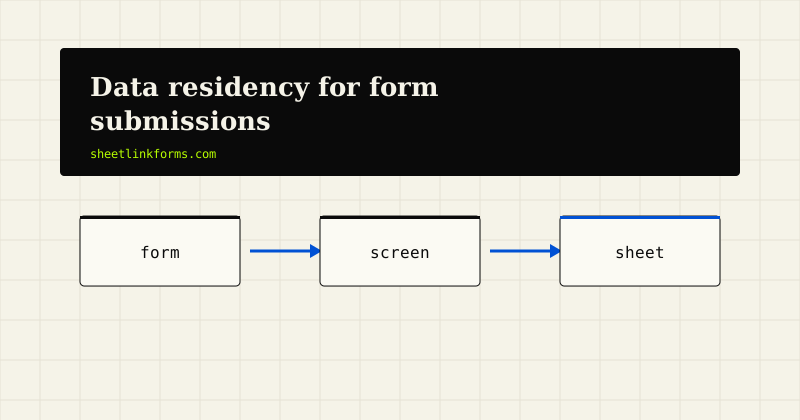
A typical chain has more hops than expected: the CDN or edge network in front of your site, the form endpoint that receives the POST, any spam-screening service, the mail relay that sends notifications, and finally the spreadsheet or CRM where the row lands.
Each of those is a place where personal data exists, however briefly. For residency purposes the transient hops matter less than the resting places, but a procurement questionnaire will usually ask about both, and the ones people forget are the middle of the chain.
The destination is where most of the answer lives
For a pipeline that delivers into a spreadsheet, the significant location is the spreadsheet account, because that is where the data lives for its whole life. The transport is transient.
This is a genuinely useful property. It means the residency answer is largely determined by an account you already control and have already made a decision about, rather than by a vendor you would have to interrogate.
It also means the answer changes if you change destination. A workspace under a business account with a stated region is a different answer from a personal account, and that difference is worth checking before you write it on a form.
It is the same reasoning that makes the choice of destination a governance decision rather than a preference. Whichever platform holds the rows is the platform whose regional terms you are relying on, and it is far easier to point at an account you administer than to reconstruct the policy of a service in the middle of the chain.
What to ask a vendor
Four questions get you most of the way, and a vendor who cannot answer them quickly is telling you something.
Where is data stored at rest. Where is it processed, including support access. Is data retained after delivery, and for how long. What transfer mechanism applies if data leaves the region.
The third is the one people forget to ask and the one that varies most between services. A pipeline that keeps a permanent copy of every submission is a very different residency proposition from one that holds a submission briefly in order to screen, retry and deliver it, then keeps only what is needed to show you the delivery log.
Transfers are allowed, silence is not
There is a persistent belief that moving personal data outside its home region is prohibited. It is not. Recognised mechanisms exist for exactly this, and most of the internet runs on them.
What is not acceptable is being unable to say what happens. A privacy notice that lists no processors and no locations fails the transparency requirement regardless of where the servers are.
So the deliverable from this exercise is a paragraph, not a migration. Who processes enquiries, where they rest, and how long they are kept. That paragraph answers the procurement form and the regulator at the same time.
When you do need to constrain it
If a contract requires a specific region, the practical steps are narrow. Choose a destination account provisioned in that region. Check whether each intermediate service offers a regional option or can be removed from the chain. Document what remains.
A useful simplification is to reduce the number of parties rather than to negotiate with all of them. A chain with two services in it has two residency answers; a chain with five has five, and each one is a separate conversation at renewal.
This is another case where consolidating where submissions live pays off for reasons that have nothing to do with tidiness.
Writing the answer down
Keep a short document with the chain, the resting places, the retention periods and the transfer basis. Update it when you change any tool. It will take an hour to write once and will answer every future questionnaire in minutes.
It also makes the transparency obligation straightforward, because the privacy notice becomes a summary of a document you already maintain rather than something drafted from memory each time.
The realistic conclusion
Most small businesses do not need to relocate their data. They need to be able to describe it.
Trace one submission, write down what you find, choose destinations deliberately, and prefer fewer parties in the chain. That covers the commercial question, the legal question and the awkward procurement form in the same afternoon.
And keep the document current, because the value is entirely in it being true. A residency answer written eighteen months ago, before you changed form tools and moved the spreadsheet to a shared workspace, is worse than no answer at all: it will be quoted back to you by the customer who relied on it.
FAQ
Is storing form data outside the EU allowed?
Yes, using a recognised transfer mechanism. The requirement is a lawful basis for the transfer and transparency about it, not an absolute prohibition. Many everyday services operate on exactly this footing.
How do I find out where my form tool stores data?
Check the documentation and the data processing terms first, then ask directly. Ask specifically about storage at rest, processing including support access, and retention after delivery, since those three are often answered differently.
Does using a spreadsheet destination simplify the answer?
Considerably, because the resting place becomes an account you already control and have already chosen a region for. The delivery service is then a transient processor rather than the long-term custodian.
What about CDNs and edge networks?
They handle data in transit and are part of an accurate chain description, but they are rarely the substance of a residency concern. Resting places matter most and are what procurement questions are usually aiming at.
Do I need to name every processor publicly?
You need to be able to describe the categories and provide details on request. Many organisations publish a list because it is easier than answering the same question repeatedly, and it reads as confidence rather than exposure.
What if a customer insists on in-country storage?
Then it is a contractual requirement and the practical route is a destination account in that region plus a chain with as few intermediaries as possible. Document what remains and be precise about it.
Is this the same as sovereignty requirements?
Related but stricter. Sovereignty arguments usually concern which government could compel disclosure, which depends on the operator rather than only the server location. If a customer raises that specifically, it needs a proper answer rather than a region setting.
Does a shorter chain really help?
Materially, yes. Each additional service in the path is another set of terms to read, another region to establish, another support-access question and another renewal conversation. Removing one intermediary removes all of that permanently, which is usually cheaper than negotiating regional commitments with a vendor you could have done without.
You choose the destination
Submissions are delivered into your own spreadsheet account, so the resting place of your data is governed by the account you already have.
Start freeSee the live demoPersonal data in spreadsheets: a risk checklistDeletion requests when your CRM is a sheet